The transformation at a glance...
£250K+
Annual turnover
£39K
Increase in gross profit
£26K
Savings in food and drink costs
£13k
Additional gross profit from pricing
Timeframe: 12 months.
Outcome: £39,000 additional gross profit through menu simplification, better portion control, reduced food waste and improved pricing.
When I first sat down in this Manchester café with its owner, the business looked busy.
Annual turnover was just over £250,000, but the gross profit margin was far too low.
The owner, Alison, knew the business should be doing better but couldn’t quite see where the money was disappearing.
We needed to understand where the money was going once those customers walked through the door.
The problem wasn't the sales. It was the PROFIT that was left over...
The first thing we looked at was the low gross profit margin.
At 42%, too much of every pound coming through the till was being spent on food and drink
And when you’re running a café, that can happen surprisingly easily.
- A few extra ingredients here.
- A little food waste there.
- Too many different products to keep in stock.
- Portions that aren’t quite consistent.
Staff spending too long preparing complicated orders.
Individually, none of these things feels particularly significant.
But put them together across thousands of transactions and the effect on profit can be sizeable.
The Plan: Make four relatively simple changes to increase profit
Step 1: Simplify the menu
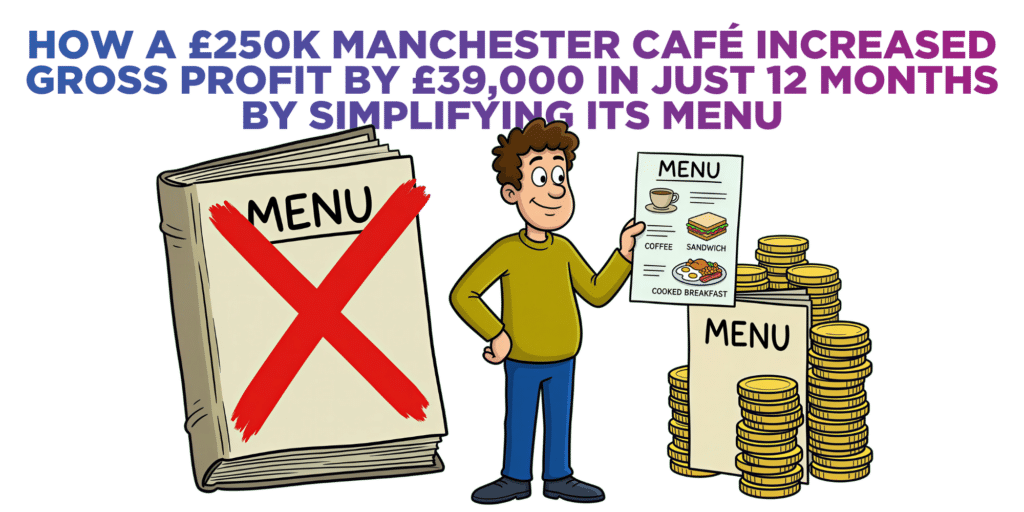
The original menu was huge – it was almost the size of a small book.
If you wanted a sandwich, for example, you could choose from six different bread options.
At first glance, giving customers lots of choice sounds like good customer service.
But more choice creates complexity.
More ingredients need to be bought.
More stock needs to be stored.
More ingredients are likely to go unused.
Staff have more decisions to make.
And complicated orders take longer to prepare.
The menu had to be dramatically shortened and simplified.
We reduced the number of options and focused on the products that customers wanted and that made commercial sense for the business.
The result was much more than a shorter menu.
The café became easier to run.
There were fewer ingredients to buy, less stock sitting in the fridge and less food going to waste.
The team could prepare orders more quickly because they weren’t constantly working through dozens of different combinations.
And because the menu was simpler, it was easier to maintain consistent portion sizes too.
That matters because a small difference in portion cost, repeated hundreds of times, can have a surprisingly big impact on your gross profit.
The simplified menu, combined with better portion control, reduced food and drink costs from 42% of sales to just over 30%.
This reduced cost and increased gross profit by £26,000.
Step 2: Make it easier for customers to buy
We then split the offer into a simple breakfast menu and a lunch menu.
Instead of asking customers to work their way through a huge menu and figure out what they wanted, we made the buying decision much easier.
Customers could quickly see what was available depending on the time of day.
The result was a quicker, simpler buying experience for customers.
Step 3: Increase the prices
Prices hadn’t changed for a couple of years.
Changing to a new menu was a perfect opportunity to change the prices too.
On average they went up by 5%.
The price increase generated an additional £13,000 of gross profit.
The price increases meant the café generated more gross profit from each sale, while the simplified menu also reduced the cost of producing many of those meals.
Higher prices + lower cost per portion = a much healthier gross profit margin.
And importantly, sales increased rather than falling.
Step 4: Let the numbers tell us what was working
Rather than making these changes and then hoping for the best, we watched what happened to the numbers.
That’s important because improving a business isn’t about finding one magic idea.
It’s about making a change, measuring the result, learning from it and then making the next decision.
The numbers quickly showed that the changes were working.
Within a year the gross profit margin had markedly increased meaning there was around £39,000 of additional gross profit.
But the improvement wasn’t just about the extra money generated from higher prices.
The café was also buying less stock, wasting less food and requiring fewer staff during peak periods because meals could be prepared much more quickly.
The Results – £39,000 more gross profit!
The key was understanding where the café was making money – and where it was losing it
By simplifying the menu, making the buying process easier and increasing prices, the café increased its gross profit margin and generated around £39,000 more gross profit.
There was another benefit that doesn’t always show up immediately on a profit and loss report.
The business became easier to operate.
- There was less food to order.
- Less stock to manage.
- Less waste.
- Faster preparation.
- Fewer staff required during the busiest periods.
- And a team that wasn’t having to navigate an unnecessarily complicated menu.
The Key Takeaways
(Yes, the pun is intended)
There are a few important lessons from this café that apply to many growing businesses.
More sales don’t automatically mean more profit.
If your margins are wrong, growing sales can simply mean you’re working harder for very little reward.
Complexity costs money.
Too many products, processes and choices can increase waste, labour costs and stock requirements.
Don’t be afraid of increasing prices.
If your prices aren’t producing a healthy margin, more sales may make the problem worse.
Make buying easy.
Customers don’t necessarily want more choice; often they want you to make it easy for them to make a decision.
Know your gross profit margin.
It is one of the most important numbers in any product-based or hospitality business – small improvements can lead to a big increase in gross profit.
Could your business be making more profit?
If you’d like to understand where your business could improve its profit and cash flow, get in touch.
To get in touch you can drop us an email to [email protected] or call one of the team on 0161 410 0020.
Disclaimer
Whilst all case studies are true, names and details may have been changed for confidentiality. Numbers, results and actions have NOT been changed. You must take professional advice before making any decisions based on the information that you have learnt here. While every effort has been made, to make sure it is accurate it cannot be precisely tailored to your personal circumstances. This article is for general information only and no action should be taken, or refrained from, as a result of this information. Professional advice should be taken based on specific circumstances in each individual case. Whilst we endeavor to ensure that the information contained in the article is correct, no liability will be accepted by Krystal Clear Accounting which is a trading name of Kim Marlor Associates Ltd or damages of any kind arising from the contents of this communication, or for any action, inaction or decision taken as a result of using any such information.