The transformation at a glance...
£1.5M
Annual turnover
£80k+
Projected cash flow shortfall
6 months
Warning before cash runs short
24 months
Profit and cash flow forecast
Timeframe: 24-month financial forecast.
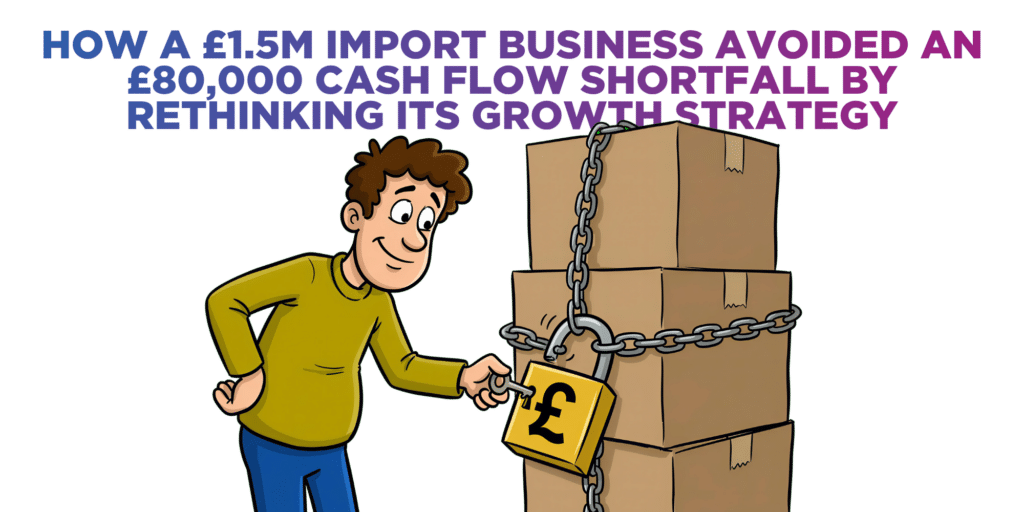
Outcome: A projected £80,000 cash flow shortfall eliminated through a revised growth strategy, scenario planning and targeted working capital funding.
Growing sales is usually something to celebrate. But what happens when the growth you want to achieve could leave your business short of cash?
That was the exact concern facing the owner of a consumer product import business generating £1.5 million in annual sales. The business sold products to both consumers and other businesses.
The owner was excited by an opportunity to significantly increase business-to-business sales by expanding a specialist product range with particularly attractive profit margins.
However, there was a concern about how much cash would be needed to fund the additional stock purchases and whether the business could afford to support the planned growth.
There was a nagging fear that the business could run out of money, even if sales and profits were increasing.
Rather than take a chance and hope the cash would be available when needed, we recommended preparing a detailed 24-month profit and cash flow forecast.
What followed gave the owner a much clearer understanding of the financial implications of the growth plan and, ultimately, the confidence to make better-informed decisions.
Understanding the real cash flow challenge
Before looking at the numbers, we needed to understand how the business operated and what would change as the specialist product range expanded.
We analysed three important areas:
- Gross profit margins across the business.
- Monthly overhead costs and how these might change as the business grew.
- The cash cycle, particularly the time between paying suppliers and receiving money from customers.
It was the cash cycle that highlighted the potential problem.
The business had to pay suppliers upfront. The products then spent approximately four weeks in transit before arriving in the UK.
Once the product arrived, it could take another month to sell it.
Business customers buying on credit would then have a further 30 days to pay.
In other words, there could be roughly three months between paying for the products and receiving the money from customers.
That’s a long time for a business to have its cash tied up in stock and then waiting for customers to pay their invoices
And there was another consideration.
Growing sales would require larger stock purchases. The business would also need to hold more stock to maintain product availability, potentially requiring additional warehouse space and staff.
Our analysis revealed that the amount of stock tied up in transit would be considerably greater than the owner had originally anticipated.
This matters because the business has already paid for the products, even though they have not arrived in the UK and cannot yet be sold.
The business could be making more sales and generating healthy profits while simultaneously experiencing a significant increase in the amount of cash needed to operate.
The challenge wasn’t profitability it was funding the working capital required to support growth.
Understanding the real cash flow challenge
We recommended preparing a detailed 24-month profit and cash flow forecast.
The objective was to answer three important questions:
- When would the business experience a cash flow shortfall?
- How long would the shortfall last?
- What would be the maximum amount of additional funding required?
We also wanted the forecast to allow us to explore different scenarios.
This meant we could change assumptions, such as the rate of sales growth, stock purchasing requirements and operating costs, and immediately see how those changes affected the business’s financial position.
The initial forecast revealed something the owner had been right to be concerned about.
Based on the original growth plan, the forecast showed that the business would run short of cash in just six months.
The shortfall was expected to last approximately 12 months, with a peak funding requirement of just over £80,000.
This was a significant finding.
Until then, the owner suspected the business might run out of cash but had no clear idea whether this would actually happen or how much additional funding might be needed
Now we had a much clearer picture.
The original growth plan would create a substantial working capital requirement that needed to be addressed.
Importantly, the forecast also gave the owner time to do something about it.
There were six months before the projected cash shortfall began. Rather than waiting until the business was struggling to pay suppliers or meet other commitments, we could explore the options while there was still time to make decisions.
Developing a more sustainable growth plan
With the potential cash requirement identified, we used the forecasting model to explore different ways of managing it.
We considered the effect of slowing down sales growth and assessed how different growth assumptions would influence stock requirements, cash flow and the overall financial position.
We also considered the types of external finance that might be suitable for the business’s working capital requirements.
This was important because the right funding needs to reflect how a business operates.
An importer that pays suppliers months before receiving money from customers has very different funding requirements from a business investing in machinery or premises.
By exploring different scenarios, we identified a revised growth plan that would put less pressure on the business’s cash flow while still allowing it to take advantage of the opportunity.
The owner decided to slow down the rate of sales growth during the first 12 months.
This would reduce the amount of additional stock the business needed to purchase and help conserve cash while the specialist product range expanded more gradually.
We also considered the funding required to support the initial bulk stock order. The owner decided to take out a small working capital loan to provide additional reassurance that sufficient cash would be available when the order was placed.
We then updated the forecast to reflect these decisions.
The updated forecast showed that, based on the revised growth plan and funding arrangements, the business was no longer expected to experience a cash flow shortfall.
The growth opportunity hadn’t disappeared. The owner had simply found a more sustainable way to pursue it without putting unnecessary pressure on the business’s cash resources.
The Outcome – Greater financial clarity & confidence
The business is now on track to achieve its revised growth plan.
But the biggest benefit wasn’t simply having an updated forecast. It was that the owner now understood the financial implications of the growth plan and could make decisions with much greater confidence.
At the beginning, the owner was becoming increasingly worried about the possibility of running out of money.
There was an attractive growth opportunity, but no clear understanding of how much cash would be required or when it would be needed.
That uncertainty was creating considerable stress.
Having a detailed forecast gave the owner something they hadn’t had before: a clear picture of what was likely to happen to the business’s cash position over the next 24 months
Rather than worrying about whether the business would have enough money, there was now a plan for managing growth and the funding needed to support it.
The owner could now make decisions based on a clear understanding of the financial implications, rather than worrying about what might happen.
Of course, a forecast cannot guarantee that everything will happen as planned.
Sales might be slower or faster than expected, suppliers might change their terms and costs could increase.
The forecast needs to be reviewed and updated as circumstances change.
But it had achieved exactly what we wanted: it had helped the owner identify a potential problem early enough to do something about it.
Four lessons other business owners can learn from this experience
There are some valuable lessons from this experience that apply to many growing businesses.
1. Profitable growth doesn’t automatically mean better cash flow.
If you pay for stock, materials, staff or other costs before receiving money from customers, growing sales can increase the amount of cash your business needs. Profit and cash flow need to be considered together.
2. Understand your cash cycle before accelerating growth.
Knowing how long it takes to turn money spent on stock into money received from customers is essential. The longer that cycle, the more working capital your business is likely to need.
3. A cash flow forecast should help you make decisions, not just predict what might happen.
An insightful forecast allows you to explore different scenarios, understand the financial consequences of your options and make changes before problems arise.
4. The best growth plan isn’t necessarily the fastest growth plan.
Sometimes slowing down slightly can put your business in a much stronger financial position. The objective should be to achieve profitable, sustainable growth without putting unnecessary pressure on cash flow.
Could better financial forecasting help your business?
If you’re planning to grow your business, invest in additional stock, recruit more staff or expand into new markets, it’s important to understand what those decisions could mean for your cash flow.
You might be making healthy profits and seeing sales increase, but that doesn’t necessarily mean you’ll have enough money in the bank to fund your plans.
A properly prepared profit and cash flow forecast can help you see what’s coming, identify potential cash shortages and understand whether additional funding might be needed.
More importantly, it gives you the opportunity to make changes before cash flow becomes a problem.
If you’d like to understand what your business’s financial future might look like and how to fund your growth plans without putting unnecessary pressure on cash flow, get in touch with Krystal Clear Accounting.
To get in touch send an email to [email protected] or call us on 0161 410 0020.
Disclaimer
Whilst all case studies are true, names and details may have been changed for confidentiality. Numbers, results and actions have NOT been changed. You must take professional advice before making any decisions based on the information that you have learnt here. While every effort has been made, to make sure it is accurate it cannot be precisely tailored to your personal circumstances. This article is for general information only and no action should be taken, or refrained from, as a result of this information. Professional advice should be taken based on specific circumstances in each individual case. Whilst we endeavor to ensure that the information contained in the article is correct, no liability will be accepted by Krystal Clear Accounting which is a trading name of Kim Marlor Associates Ltd or damages of any kind arising from the contents of this communication, or for any action, inaction or decision taken as a result of using any such information.