The transformation at a glance...
£500K
Annual turnover
16
Team members
£60K
Annual loss before changes
£100K
Improvement in annual profit
Timeframe: 12 months.
Outcome: Improvements came from treatment profitability analysis, pricing, productivity and better use of customer data.
Anne had built a successful beauty salon from the ground up, with annual sales of around £500,000 and a team of 16 people.
To the customers and staff all looked good in the salon – except that it wasn’t. The salon was losing around £5,000 a month. Once loan and debt repayments were included, the cash leaving the business was closer to £8,000 a month.
Anne had worked incredibly hard to rebuild the business after COVID, but she was exhausted, worried about the bank balance and, most frustratingly, didn’t know what was causing the losses or what she needed to change.
She knew something had to change.
She just didn’t know where to start.
From surviving to understanding the numbers...
Anne’s salon had somehow survived COVID, but survival had come at a heavy cost. For around 18 months, there had been very little income, so the business had relied on company loans and credit cards to keep going.
Once restrictions were lifted, Anne and her staff put an enormous amount of effort into rebuilding the business.
It was painful and gradually the salon became busy again.
But being busy doesn’t mean the business will be profitable.
The bank balance was telling Anne that something wasn’t right, but she didn’t have the financial information she needed to understand why.
She had annual accounts, but they usually arrived eight months after the year end. By then, they were historical and didn’t give her the information she needed to make decisions about the business.
That was when Anne was introduced to Krystal Clear Accounting.
The objective was to answer a single question:
“Where are we actually making money, where are we losing money, and what can we do about it?”
That was the point when the five-step transformation started.
Step 1: Getting the TRUE profitability of the salon
The first thing we did was take over the bookkeeping and change the way the financial information was presented.
One of the biggest changes was moving the staff costs into Cost of Sales.
That might sound like a small accounting adjustment, but it made a huge difference.
In a people-based business such as a beauty salon, staff time is one of the biggest costs of delivering the service.
If you don’t properly account for that cost when looking at profitability, it can make the business appear healthier than it really is.
We wanted Anne to see the true profitability of the salon, rather than simply looking at turnover and a gross profit figure that was misleading.
Once we could see the numbers clearly, we could identify where the salon was making money, where it was losing money and what needed to change.
Step 2: Finding out which treatments actually made money
The next step was to look underneath the headline figures.
It’s very easy for a business owner to look at £500,000 of sales and think, “We just need more customers.”
But what if some customers, products or services are significantly more profitable than others?
That was exactly what we found.
We analysed the profitability of the salon’s main treatments so that Anne could see which treatments were worth growing and which were not contributing enough profit for the time involved.
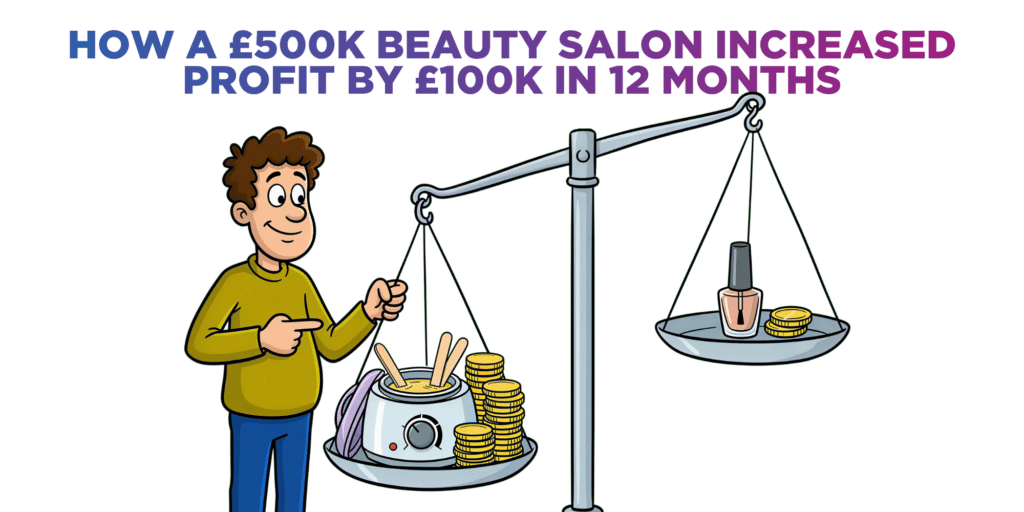
Waxing stood out as particularly profitable.
Nails, on the other hand, were one of the least profitable areas.
That was an important discovery.
The objective wasn’t simply “get more bookings.”
It became: “Get more of the right bookings.”
We also looked at revenue per employee.
This gave us a much clearer understanding of productivity across the team and helped identify the most productive and least productive members of staff.
Again, this wasn’t about pointing fingers.
It was about understanding the numbers so that Anne could make sensible decisions about training, performance and how the team spent its time.
Step 3: Increasing prices where the salon was undercharging
The numbers also highlighted another problem – the salon was undercharging for some of the services it was providing.
Like many business owners, Anne had been reluctant to increase prices.
There’s always that worry that customers will complain, go somewhere cheaper or simply stop coming.
But we could see where the business wasn’t charging enough to properly cover the cost of delivering certain treatments.
Prices were increased.
Step 4: Getting more productivity from the team
When you have 16 people working in a business, even relatively small improvements in the amount of time taken to deliver a treatment can have a significant financial impact.
We looked at how treatments were being delivered and established best practice for each treatment.
Once the team had had the extra training, the time taken to deliver treatments noticeably fell. As a result, the team were able to be more productive within the hours they were already working.
We also changed settings within the Phorest software to support the way appointments were being managed.
The aim was to make the team work more productive by making better use of the hours already being paid for.
A business doesn’t always need more staff, longer hours – sometimes it simply needs to get more value from the capacity it already has.
Step 5: Using the data to sell more of the right services
With the profitability data and productivity information available, we could then start changing what the salon actively focused on.
Being highly profitable, we focused on selling more waxing appointments.
At the same time, we restricted availability of nail-only appointments in Phorest software as nails were the least profitable.
We also analysed the customer data within Phorest.
This allowed us to identify opportunities to bring existing customers back more frequently and encourage customers to try treatments they hadn’t previously booked.
Campaigns and targeted offers were created around this information.
So rather than constantly relying on finding new customers, the salon was able to make better use of the customers it already had.
The Results – Sales up & £100,000 more profit!
Within 12 months, the transformation was significant.
The salon was no longer losing money.
More importantly, the underlying profitability of the business had increased by around £100,000.
Instead of looking at the bank account and wondering what was going wrong, she could finally understand what was happening inside her business.
Instead of worrying about what was happening to the bank balance, Anne could see where the money was being made and what needed her attention.
There’s a huge difference between waking up wondering whether you’re going to have enough money to cover everything this month and waking up knowing where the profit is coming from, what needs attention and what you can do next.
The Key Takeaway
The transformation started with getting a proper understanding of the numbers and then making a series of better decisions.
- Better pricing.
- Better treatment mix.
- Better productivity.
- Better use of the team.
- Better use of customer data.
The biggest gains didn’t come from one dramatic change. They came from making a series of informed decisions about pricing, productivity, services and customers.
Ready to see what your numbers are really saying?
If you want more profit, more cash in the bank and a business that doesn’t depend on you working harder, let’s look at your numbers differently.
The answer as to what needs to change is almost certainly hidden in plain sight in the numbers…
To get in touch you can drop us an email to [email protected] or call one of the team on 0161 410 0020.
Disclaimer
Whilst all case studies are true, names and details may have been changed for confidentiality. Numbers, results and actions have NOT been changed. You must take professional advice before making any decisions based on the information that you have learnt here. While every effort has been made, to make sure it is accurate it cannot be precisely tailored to your personal circumstances. This article is for general information only and no action should be taken, or refrained from, as a result of this information. Professional advice should be taken based on specific circumstances in each individual case. Whilst we endeavor to ensure that the information contained in the article is correct, no liability will be accepted by Krystal Clear Accounting which is a trading name of Kim Marlor Associates Ltd or damages of any kind arising from the contents of this communication, or for any action, inaction or decision taken as a result of using any such information.