
How a consumer product manufacturing factory was turned around within a year by fixing pricing strategy
A couple of weeks ago, I sat down with a driven entrepreneur who runs a consumer product manufacturing business turning over £850,000 a year.
She’s ambitious and wants to get to £1 million. But despite growing sales the profit wasn’t where it should be…and neither was the bank balance.
If you’ve ever looked at your numbers and thought, “We’re busy… so why doesn’t it feel better than this?” you’ll understand the quiet frustration she was carrying.
Because here’s the truth: scaling amplifies everything – the good and the bad.
If your margins are ‘thin’ then growth doesn’t fix that problem… it magnifies it.
Exposing the problem
Before a detailed 12-month financial plan could be built, we first had to get clarity on the underlying profitability of the business.
As we drilled into the sales and cost data the real issue revealed itself quickly.
Two core product groups, representing roughly two-thirds of her revenue, were generating a gross margin of just under 24%.
At first glance, it doesn’t look catastrophic.
But in a manufacturing business with rising costs, operational complexity and ambitions to scale, 24% is just too low.
More orders would simply mean more activity, more stress and very little additional profit.
And that’s not the kind of business or growth anyone wants.
The Pricing Strategy Problem: Fixed
Once the numbers were laid bare, the path forward became surprisingly clear…
Step 1: Define the "Core Range"
We identified which products truly formed the backbone of the business: the scalable, repeatable, high-volume lines.
Everything else was just a distraction but disguised as opportunity.

Step 2: Reprice with confidence
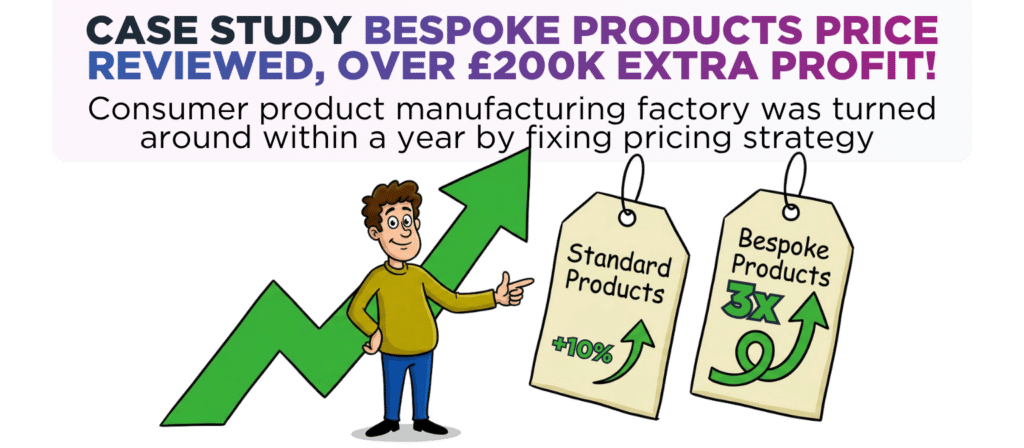
The core range saw a straight 10% price increase. This was backed by margin analysis, which showed that the underlying profitability wasn’t high enough.
Then we looked at the long tail of bespoke, one-off products. These were consuming disproportionate time and resource for minimal return.
The pricing tripled.
Yes, tripled.
Because bespoke work is a premium offering, and that comes with a premium price.
Except this hadn’t been the case for this manufacturer – there was little difference in price between standard and bespoke products.
Step 3: Build a 12-month financial roadmap
We modelled the impact. We stress-tested assumptions. We created visibility. It meant that for the first time ever she wasn’t guessing anymore.
And that was the turning point.
The Results: HUGE amounts of extra profit!
An additional £201,000 per year in profit purely from a smarter pricing strategy.
- No extra marketing spend.
- No new hires.
- No doubling of workload.
She’s no longer chasing turnover and hoping profit will come. She now understands exactly how her business makes money and how every product should be profitably priced.
Key Takeaway
This case highlights something every ambitious business owner needs to hear:
Growth without margin is just stress at scale.
To grow with confidence, you need:
- To truly know your numbers
- To understand the profitability of each core product or service
- To build a clear, forward-looking financial plan
When you have those three things, decisions become simpler. Pricing becomes strategic and growth becomes profitable.
If you’re turning over £500k and pushing hard to grow, but you’re not seeing the profit or cash reflect your effort, it’s time to look properly into the numbers.
Because scaling should feel exciting. Not exhausting.
If you want to use numbers to find out where your profit is hiding in your business and unlock it, then let’s have a conversation...
To get in touch you can drop us an email to [email protected] or call one of the team on 0161 410 0020.
Disclaimer
You must take professional advice before making any decisions based on the information that you have learnt here. While every effort has been made, to make sure it is accurate it cannot be precisely tailored to your personal circumstances. This article is for general information only and no action should be taken, or refrained from, as a result of this information. Professional advice should be taken based on specific circumstances in each individual case. Whilst we endeavor to ensure that the information contained in the article is correct, no liability will be accepted by Krystal Clear Accounting which is a trading name of Kim Marlor Associates Ltd or damages of any kind arising from the contents of this communication, or for any action, inaction or decision taken as a result of using any such information.