Skip to content

How will the Associated Companies rules affect the Corporation Tax a Limited Company pays?

From 1st April 2023 the new corporation tax rules mean there will now be two things which affect the corporation tax rate and therefore the amount of corporation tax a company will pay.

Firstly, the amount of profits made.

Secondly, the number of ‘associated’ companies it has.

Knowing what constitutes an ‘associated company’ will become an important piece of information as it will affect the amount of corporation tax a company will pay.

This article will summarise the main rule changes and how they are likely to affect you.

Let’s get started.

What are the New Corporation Tax Rules?

From 1 April 2023 the rate of corporation tax a company will pay will be largely determined by how much profit that company makes.

Taxable profits over £250,000 – corporation tax rate of 25%.

Taxable profit of £50,000 or less – corporation tax rate of 19%

Taxable profit between £50,000 and £250,000 – corporation tax rate of 19% on first £50,000 and then 26.5% on any profits made between £50,000 and £250,000.

How does the number of Associated Companies affect Corporation Tax?

From 1st April 2023 the taxable profit threshold figures of £50,000 and £250,000 will be divided by the number of associate companies.

SO.

IF a company has one other company which is associated then the profit thresholds will be divided by two. This means the corporation tax rates which would apply would change to :-

Taxable profits over £125,000 – corporation tax rate of 25%.

Taxable profit of £25,000 or less – corporation tax rate of 19%

Taxable profit between £25,000 and £125,000 – corporation tax rate of 19% on first £25,000 and then 26.5% on any profits made between £25,000 and £125,000.

Worked Example

Company A makes a profit of £100,000 & has no associated companies.

Will pay £22,750 corporation tax.

Company A makes a profit of £100,000 & has company B as an associated company.

Will pay £24,625 corporation tax.

That’s an extra £1,875 corporation tax to pay just because it has a single associated company.

What makes a company 'Associated'?

A company is associated with another company IF one is under the control of the other.

Companies are usually associated with each other where they are under ‘common’ control.  The two key words here are common and control.

  • Common means both companies are controlled by the same person (or persons).
  • Control means a person has more than 50% of the share capital, or voting power, of a company.

That means common control will exist where companies have a shareholder or same group of shareholders that own more than 50% of the share capital.

Are there any exceptions?

There are indeed some exceptions and the main three are listed below.

IF any of the following exceptions apply then that company won’t be considered to be associated with another.

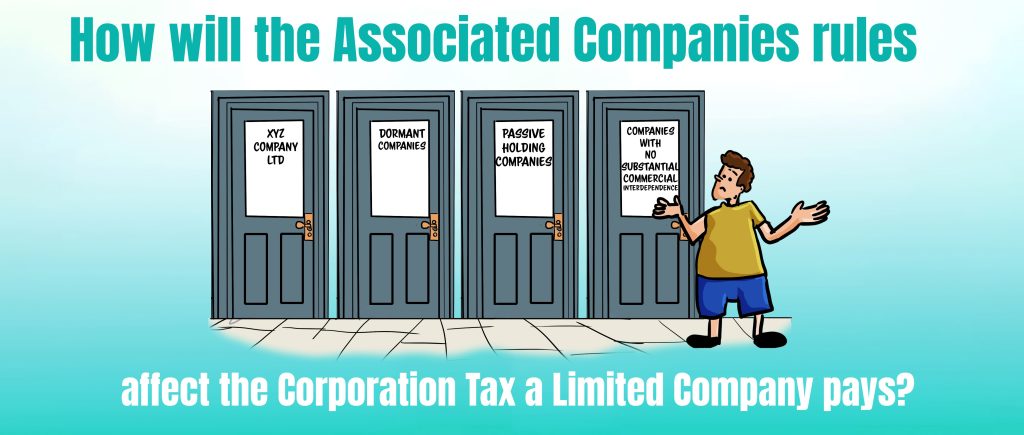
  1. Dormant companies. Are excluded completely.
  2. Passive holding companies. These companies do nothing other than receive dividends from subsidiary companies and pay dividends to its shareholders. Other than that the company has no other activity.
  3. Companies with NO substantial commercial interdependence. So, companies may be under common control BUT if there’s no substantial commercial interdependence then they won’t be considered to be associated.

HMRC’s guidance says two companies will be ‘commercially interdependent’ (and therefore associated) IF ANY of the following three factors apply.

  • Financially interdependent

This means that one company is supporting the other.

Eg By lending it money or guaranteeing its borrowings, or if they both have a financial interest in the same business.

  • Economically interdependent

This is where they have the same economic objectives, or where the activities of one company benefit the other, or where they have customers in common.

  • Organisationally interdependent

This occurs where the two companies share the same resources.

Eg Have same management, employ the same people, share premises or equipment.

In Summary

It is now important that business owners have clarity on which of their companies are under common control and therefore could be associated.

If there are any potentially associated companies then steps should be taken to reduce the amount of commercial interdependence so that it isn’t substantial.

Doing this will reduce the number of associated companies and therefore avoid paying higher amounts of corporation tax.

A good accountant will be able to help you clarify the number of companies to be treated as associates, and highlight opportunities to reduce the number to save you tax.



Disclaimer
It is important that you take professional advice before making any decisions based on the information that you learnt here. While every effort has been made to make sure it is accurate it cannot be precisely tailored to your personal circumstances. This article is for general information only and no action should be taken, or refrained from, as a result of this information.  Professional advice should be taken based on specific circumstances in each individual case.  Whilst we endeavour to ensure that the information contained in the article is correct, no liability will be accepted by Krystal Clear Accounting which is a trading name of Kim Marlor Associates Ltd or damages of any kind arising from the contents of this communication, or for any action, inaction or decision taken as a result of using any such information.

What are Bank Feeds and how do they work?

Related Articles

[related_posts_grid]

In short, bank feeds create a digital link between your business bank account and your accounting software, such as Xero or QuickBooks.  

This means bank transactions are automatically downloaded into the accounting software. This simple piece of automation, completely removes the need to manually input every bank receipt and payment into the accounting software. 

Having bank feeds in place, saves a HUGE amount of time bookkeeping. That’s because it completely removes the need to manually input bank transactions into the accounting software. 

Saving time bookkeeping isn’t the only benefit for the business…. 


Our business owner is confused about how the new associated companies rule will affect all the companies he has

What are the main benefits to a business using bank feeds?

Bank feeds automate, what was previously, a time-consuming task of entering all the bank transactions into the accounting software. 

 This saves the business a HUGE amount of time (& money) spent on bookkeeping.  

With bank transactions being downloaded from the bank every day, it means it’s quicker and easier to keep the bank balance in the accounting software up-to date. 

With the accounting software up-to date, the bank is updated daily which gives you a clearer, real-time view of your business’s cash flow.  

This makes it easier for you to plan your cashflow, and take action to improve it. 

There is always the risk of errors being made when data is being manually inputted into the accounting system. It is often time-consuming to find and correct any errors. Also, if an error is large then the Profit & loss and Balance Sheet reports will be inaccurate and potentially misleading. 

 Automating the bank transaction entry previously manual process, reduces the risk of errors being made and ensures that the bookkeeping records and reports are accurate. 

How to Link Your Bank to Xero

Ensure that your bank account is set up for online banking. This feature is typically available from all major banks. 

Log into your Xero account and navigate to the banking section. Select ‘Add Bank Account’ and follow the prompts to search for your bank. 

After adding your bank account details, you’ll see an option to set up bank feeds. Click ‘Agree’ to the terms, then securely log into your online banking portal through Xero to authorize the connection. 


Are Bank Feeds Safe & Secure?

Yes. 

Firstly, having bank feeds in place ONLY means bank transactions are downloaded into the accounting system. They do NOT give anyone else access to the business bank account. 

 Secondly, XERO has various security measures in place to give you a piece of mind that your financial data is safe and secure: 


  • Encrypted Connections: Xero uses advanced encryption technology to secure the data transmission from your bank to Xero. This means your sensitive information is encrypted during transit and cannot be intercepted or read by unauthorized parties. 


  • Compliance and Standards: Xero adheres to high standards of data security compliance, thus ensuring that its practices meet or exceed industry security standards and regulations. 


  • Regular Renewals: To maintain a high level of security, XERO requires that the bank feed connection is renewed every 90 days. This process is straightforward and helps ensure that the integrity of your financial data is always protected. 


people are connected
KIm Marlor the MD of Krystal Clear Accounting
krystal clear accounting

In Summary

In short, having bank feeds really saves businesses time and money on their bookkeeping.  

 They automate and eliminate what is otherwise a time consuming and error prone manual process.  

 Bank feeds is just one of the ways technology can be used to help business owners improve the financial side of their business.

Request a Call Back: