What are the temporary Summer 2026 VAT reduction rules and how might they affect me?
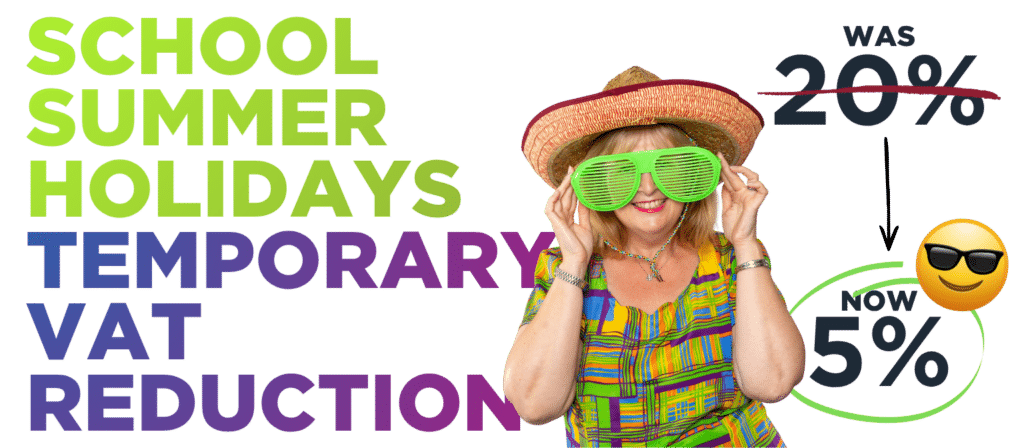
The UK government has announced VAT reductions for Summer 2026. They are introducing a temporary reduction in VAT from 20% to 5% on certain family-focused activities and services, designed to help reduce costs for families during the school holidays.
While the change only lasts for a short period, businesses in hospitality, entertainment and leisure could see a meaningful impact on pricing, demand, profitability and cashflow. Understanding exactly what qualifies – and just as importantly, what doesn’t – could help you avoid costly mistakes while making the most of the opportunity.
Which businesses might benefit from these Summer 2026 VAT reductions?
The temporary VAT cut covers three main categories…
Children's meals

Admission to qualifying attractions and family venues

Children's cinema, theatre, exhibition, concert and show tickets

For businesses operating in sectors such as restaurants, cafés, cinemas, theatres, museums, theme parks, zoos, soft play centres, visitor attractions and family entertainment venues, this creates an opportunity to either increase customer numbers and / or improve profit margins.
The key point to understand is that the reduction applies only to specific qualifying supplies. Businesses cannot simply apply the lower rate to everything they sell.
The rules focus heavily on how products and services are marketed, priced and presented to customers.
That means your menus, ticketing systems, signage, website wording and promotional materials could become just as important as your bookkeeping records.
What time period does it cover?
The Summer 2026 VAT reductions apply from 25th June 2026 until 1st September 2026 inclusive.
What are the rules for children's meals?
The reduced VAT rate applies to children’s meals when both of the following two conditions are met:
1. The meal is clearly held out for sale as a children’s meal.
2. The meal is supplied as part of catering services for consumption on the premises.
In practical terms, a dedicated children’s menu in a restaurant or café is likely to qualify.
The legislation focuses on how the meal is marketed and presented rather than who eats it. A meal does not become a children’s meal simply because a child orders it.
For example, a children’s meal deal that includes a main course, drink and dessert for a fixed price would normally qualify for the 5% VAT rate. If additional items are purchased separately, those items may not qualify and could remain subject to their normal VAT treatment.
There are also several situations that do not qualify:
• Smaller portions of adult meals
• Lower-calorie options
• Discounted adult meals
• Shared meals intended for adults and children
• Takeaway meals
• Alcoholic drinks
It’s also worth noting that a non-alcoholic drink included within a children’s meal package can qualify. However, any meal package that includes alcohol will not be treated as a children’s meal for VAT purposes.
For hospitality businesses, this means careful consideration should be given to menu design, pricing structures and point-of-sale systems during the relief period.
What are the rules for attractions?
Unlike children’s meals, the reduced VAT rate applies to all customers, regardless of age, when they are admitted to qualifying attractions.
The main qualifying attractions include:
• Soft play centres
• Indoor bounce parks
• Farm visitor attractions
• Theme, amusement, adventure and water parks
• Zoos and wildlife parks
• Observation towers & viewing attractions
• Circuses
The reduced rate applies only to the admission charge itself.
Any additional revenue streams such as food sales, drinks, merchandise, upgrades, fast-track access or other extras continue to follow their normal VAT treatment.
This distinction is particularly important because many attractions generate significant profits from secondary spending once visitors are through the gate.
Businesses will therefore need to ensure their accounting and till systems can correctly separate qualifying admission income from non-qualifying sales.
There are also special rules for multi-entry tickets and season passes.
If a ticket allows admission only during the relief period, it may qualify for the lower VAT rate.
However, where a pass allows entry beyond 1st September 2026 and is priced higher than a standard admission ticket, it generally will not qualify.
What are the rules for theatre & cinema?
The temporary VAT reduction also covers children’s admission tickets for cinema screenings, theatrical performances, concerts, shows and exhibitions.
The key factor is not who attends the event, but how the ticket is marketed, priced and presented. To qualify for the reduced 5% VAT rate, the ticket must be clearly sold as a children’s admission ticket.
Where a ticket is sold as a family admission package that includes one or more children, the reduced VAT rate can apply to the entire ticket price, including any adult admissions included within that package.
Be aware that group tickets or discounted admissions for several people will only benefit from the reduced rate if they are specifically marketed and presented as a family ticket that includes at least one child.
Anything else? Understanding "time of supply"
One important aspect of this temporary VAT reduction is the often-overlooked concept known as time of supply.
The reduced rate applies to admissions that take place between 25th June 2026 and 1st September 2026.
This creates an interesting scenario where tickets purchased before 25th June 2026 may still qualify for the reduced 5% rate IF the admission itself falls within the qualifying dates.
Equally, tickets purchased during the summer for admission after 1st September 2026 will remain subject to the standard 20% VAT rate.
Businesses can also choose to apply the lower 5% VAT rate to qualifying prepayments that have already been received. In situations where VAT has previously been accounted for at 20%, adjustments can be made through the VAT records.
The government has indicated that where customers have prepaid and businesses choose to apply the reduced rate retrospectively, customers should benefit from the VAT saving.
For many businesses, this creates both an administrative challenge and an opportunity to generate goodwill with customers.
Three practical Summer 2026 VAT reductions strategies to consider now

Review your pricing strategy
A lower 5% VAT rate creates flexibility. You could choose to pass the saving on to customers to stimulate demand, retain some of the saving to improve profit margins, or use a combination of both.
Action
Run financial projections before making changes and model the impact of different pricing options on sales volume, profitability and cash flow.

Review your menus, signage, tickets and marketing
Many businesses will qualify or fail to qualify based on how products are presented rather than what they physically are. Small wording changes could have significant VAT consequences.
Action
Review all children’s menus, ticket descriptions, website content and booking systems to ensure qualifying supplies are clearly identified and correctly marketed.

Check your systems before the temporary VAT cut begins
Temporary VAT changes often create confusion within accounting software, EPOS systems and reporting processes. Errors can quickly become expensive if left unchecked.
Action
Test VAT codes, train staff and work with your accountant to ensure qualifying sales are recorded correctly from day one.
Key takeaways
- The temporary VAT reduction from 20% to 5% runs from 25th June 2026 to 1st September 2026 and creates a valuable opportunity for many businesses to make more money.
- Children’s meals qualify only where they are clearly marketed and presented as children’s meals and consumed on the premises.
- Children’s tickets for cinemas, theatres, exhibitions, shows and concerts can qualify, while qualifying family tickets may benefit from the reduced rate across the whole package.
- Many attractions, including soft play centres, can apply the reduced rate to admission charges for all visitors.
- The rules around marketing, pricing, presentation and time of supply are critical. Getting these details right could improve profitability, attract new customers and avoid VAT compliance issues.
Want help understanding how the Summer 2026 VAT reductions will affect you and your business?
If you’re unsure whether your sales qualify, how to structure your pricing, or how the VAT changes could affect your profits and cash flow, now is the time to review your numbers.
A small adjustment today could make a significant difference to your profit, your cash position and the amount you take home from the business.
Get in touch today and let’s look at the numbers together so you can make confident decisions and maximise the opportunity this summer VAT relief creates.
If you’d like a chat to see how we can help drop us an email to [email protected] or call one of the team on 0161 410 0020. You can also click here to contact us.
Disclaimer
You must take professional advice before making any decisions based on the information that you have learnt here. While every effort has been made, to make sure it is accurate it cannot be precisely tailored to your personal circumstances. This article is for general information only and no action should be taken, or refrained from, as a result of this information. Professional advice should be taken based on specific circumstances in each individual case. Whilst we endeavor to ensure that the information contained in the article is correct, no liability will be accepted by Krystal Clear Accounting which is a trading name of Kim Marlor Associates Ltd or damages of any kind arising from the contents of this communication, or for any action, inaction or decision taken as a result of using any such information.