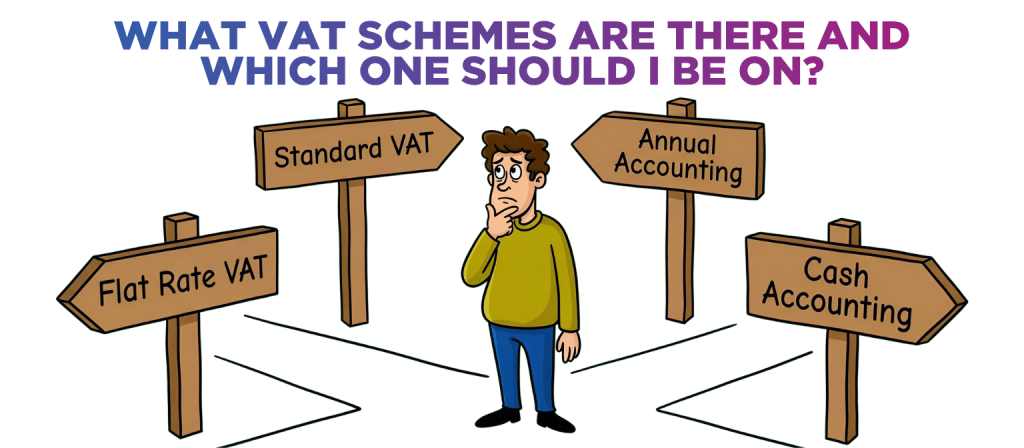
What VAT schemes are there and which one should I be on?
As an entrepreneur, VAT might seem like one of those things you’d rather ignore. But you shouldn’t.
That’s because choosing the right VAT scheme could make a real difference to your bottom line. It can impact your cash flow. It can affect how much admin and bookkeeping work you need to do. It can even impact how the profitability of your business.
In this article, we’ll break down the key VAT schemes available in the UK, so you can decide which one is right for your business.
The Main VAT Schemes

Standard VAT Scheme
This is the most common VAT scheme for businesses.
You charge VAT on your sales and reclaim VAT on your purchases.
The VAT rate is typically 20%, though it can vary depending on the goods and services you sell (e.g. some food items or children’s clothing)
Advantages:
- Straightforward and easy to manage once you’re used to it.
- You can reclaim VAT on most business-related purchases.
- No turnover limit (you can be a large business and still use this scheme).
Disadvantages:
- You’ll need to submit VAT returns monthly, quarterly or annually.
- Requires the bookkeeping to be done regularly – so the VAT return can be filed on time.
- Requires every invoice and bank transaction to be processed accurately – to ensure the VAT is correctly calculated.
- Can create cash flow challenges – as you could have to pay VAT on sales invoices which your customers haven’t yet paid.

Flat-rate VAT Scheme
With this scheme, you charge VAT at the standard rate BUT pay VAT to HMRC at a fixed percentage (based on your industry), rather than the amount of VAT you collect from your customers.
This means you don’t need to track VAT on individual purchases, simplifying the bookkeeping process.
Advantages:
- Saves bookkeeping time and cost – you don’t need to track VAT on purchases.
- Potential to increase profits and improve cash flow if your business has fewer VAT-able purchases than the standard assumption for your industry
Disadvantages:
- You can’t reclaim VAT on most purchases.
- The flat rate percentage may not be as advantageous if you have high input VAT.
- Your business must have a turnover of under £150,000 to join (excluding VAT) and you have to leave if the turnover is more than £230,000 (including VAT).
- You need to check every time you prepare a VAT return that you qualify for your industry % – if you don’t qualify then you have to use the low-cost trader % which may not be attractive for most businesses.

Annual Accounting Scheme
This scheme allows you to submit just one VAT return a year, but you make quarterly or monthly payments based on estimated VAT.
This could help if you prefer to deal with your VAT obligations in a less time-consuming way.
Advantages:
- Less paperwork, with only one return each year.
- Easier cash flow management as you make smaller payments during the year.
- Useful for businesses with relatively steady sales.
Disadvantages:
- Estimated VAT payments could be too high or too low, leading to underpayments or overpayments.
- You still need to track your VAT quarterly, even though you’re only submitting an annual return.

Cash Accounting Scheme
Under this scheme, you only pay VAT when you receive payment from your customers, and you can reclaim VAT when you pay your suppliers.
This scheme is ideal for businesses with cash flow challenges.
Advantages:
- Helps cash flow, as you only pay VAT when you’ve been paid by your customers.
- Simplifies accounting as VAT isn’t due until you’ve received payment.
Disadvantages:
- You must have a turnover of under £1.35 million to use this scheme.
- May not suit businesses who are paid by customers straightaway BUT get credit from their suppliers meaning purchase invoices are paid later.
Key Takeaways
Selecting the right VAT scheme is more than just ticking a box – it’s a strategic choice.
One that impacts how you manage your cash flow, your time, and your bottom line.
It’s important to take the time to choose the right scheme for you and your business, as it could save you time, money, and increase profits down the line.
Want help choosing the right VAT scheme for your business?
If you’d like a chat to see how we can help drop us an email to [email protected] or call one of the team on 0161 410 0020.
Disclaimer
You must take professional advice before making any decisions based on the information that you have learnt here. While every effort has been made, to make sure it is accurate it cannot be precisely tailored to your personal circumstances. This article is for general information only and no action should be taken, or refrained from, as a result of this information. Professional advice should be taken based on specific circumstances in each individual case. Whilst we endeavor to ensure that the information contained in the article is correct, no liability will be accepted by Krystal Clear Accounting which is a trading name of Kim Marlor Associates Ltd or damages of any kind arising from the contents of this communication, or for any action, inaction or decision taken as a result of using any such information.