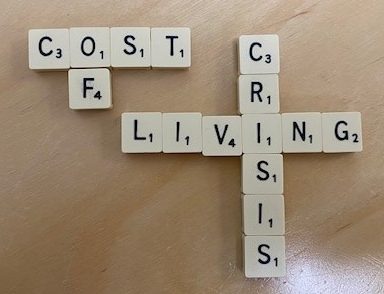
Life for business owners, having survived the Covid19 pandemic, is unlikely to be easy any time soon. The cost of living crisis is upon us. Soaring fuel and energy costs. Rising inflation. Rising interest rates. Difficulty in finding good staff. Falling consumer confidence.
It all explains why recent research found that 23% (ie almost a quarter) business owners were worried their company would fail and not survive the current financial year.
So what business costs should you cut to give your business the best possible chance to survive the current cost of living crisis?
This article will answer that question by outlining a number of simple strategies that any business owner can use to reduce their business costs and conserve cash.
Let’s get started…
What business costs could I reduce?
Before deciding which costs to reduce it’s important to first clarify the three main types of business cost which every business has. These are:-
1 Cost of producing a product or delivering a service
These are costs which are directly linked to a sale. These costs must be incurred in order for a business to make a product or deliver a service to a customer.
Some examples of which are:-
- For a manufacturer that means the cost of factory staff & raw materials
- For a printer that means the cost of paper & ink & printing staff
- For a web designer that means the cost of web hosting fees & images.
ALERT
Remember these costs are directly linked to a sale so these costs are hard to significantly cut WITHOUT adversely effecting (ie reducing) your the sales price and/or quality of your service/product.
2 Business running costs
These are the day-to-day business costs and are commonly referred to as overheads. These costs aren’t directly linked to a sale. They typically include:-
- Premises costs : rent, rates, utilities, repairs, etc
- Marketing costs.: pay per click, Facebook ads, flyers, etc
- Staff costs : staff wages, sub-contractor cost, etc
- Office costs : stationery, insurance, accountancy, IT, telephone, etc.
- Finance costs : bank charges, loan interest, etc
Whilst none of these are linked directly to a sale most are still needed, to some degree, if a business is to function. Without them it simply won’t be able obtain or retain customers, eg a telephone is needed to communicate with customers.
3 Tax costs
A business which makes a profit will have to pay some tax – corporation tax paid by limited companies and Income tax & national insurance paid by sole trades and partnerships.
Tax is another cost which ultimately reduces the bank balance.
HOW CAN I REDUCE MY BUSINESS COSTS?
The three BEST ways to reduce the business costs of their business are:-
- CUT WASTE – eg stop IT software subscriptions that no one uses any more
- INCREASE EFFICIENCY / CHANGE WHE WAYS THINGS ARE DONE– eg improve manufacturing process meaning fewer raw materials are bought and/or less staff time (& cost) is needed.
- PAY LESS – BUT ONLY IF the quality is not compromised and doesn’t changed
Why are these the BEST ways to reduce cost…?
Quite simply these ways reduce the business costs and save cash business BUT they’re unlikely to impact customers. The customers will continue to receive the same service or goods at the same price. Nothing changes.
BUT. If they believe or see the quality of the goods / service that they are getting has gone down then you can expect those customers to be unhappy.
They might insist on paying less – resulting in lower sales and profits.
They might leave and go elsewhere – resulting in lower sales and profits.
So, if the wrong costs are cut then the knock-on effect on customers might mean the business ends up in a worse position rather than a better one.
POSSIBLE IDEAS TO REDUCE YOUR BUSINESS COSTS
- Review bank and credit card statements
Someone should review every line on the business bank and credit card statements for certainly the last month but ideally for the last 3 months. This is to…
1 Ensure you know what each cost is for – any that aren’t recognised should be cut.
2 Consider if there is anything (especially look at IT software and subscriptions) might not be needed any more and could be stopped to save cash.
This exercise should be repeated every 3 months so that any opportunity to reduce unnecessary costs isn’t missed.
- Have standard processes
Having ‘standard’ processes and systems for all the main tasks in a business reduces waste, reduces the number of errors and ultimately can save the business a lot of money.
To be effective processes and systems must be written down, easy to follow and clearly sets out how a task should be done. Everyone must also follow them.
- Find a better way – use technology
Any process or system which is still manual will tend to be inefficient – in terms of taking more time and incurring more cost.
To improve efficiency and save business costs all the main processes and systems should be reviewed to see if certain tasks can be (1) stopped altogether or (2) improved and made more efficient.
Using technology is one way to improve efficiency because it can be used to completely automate and replace manual processes. More automation ultimately saves a business time and money.
- Review your return on your marketing
Lots of businesses spend a fair amount of cash on marketing every month BUT DON’T if they’re getting a good return or not for what they’re spending.
That’s because they DON’T really know their numbers.
To work out how good the return is you need to compare the marketing spend (in say a month) against the expected revenue from the new customers generated from that marketing.
This exercise should be done by marketing pillar (eg Pay per click, Facebook Ads, Flyers, etc) because it allows the business owner to assess what part of the marketing is working and what isn’t.
Any marketing which is performing poorly can either be stopped (which saves cost) or its cost re-allocated to marketing which is performing much better (which increase sales revenue).
- Make sure you are tax efficient
A good accountant will be able to help you claim all the tax reliefs you’re entitled so that you don’t pay a penny more in tax than you’re legally entitled to.
FINAL THOUGHT
Cutting costs in order to conserve cash is important. To do that effectively it’s to assess your options before deciding what changes to make in the business which reduce cost BUT which don’t adversely affect the customers
It is also important to remember that there are two ways to make more profit and generating cash. One is to reduce cost. The other, which is often overlooked, is to increase sales revenue.
Important…
If you found this article helpful then you can discover more useful information about how to increase sales and profit in our article ‘How can my business survive the cost of living crisis ?’.
If you’d like to discuss any of the above or would like a chat to see how we can help drop us an email to [email protected] or call one of the team on 0161 410 0020.


