
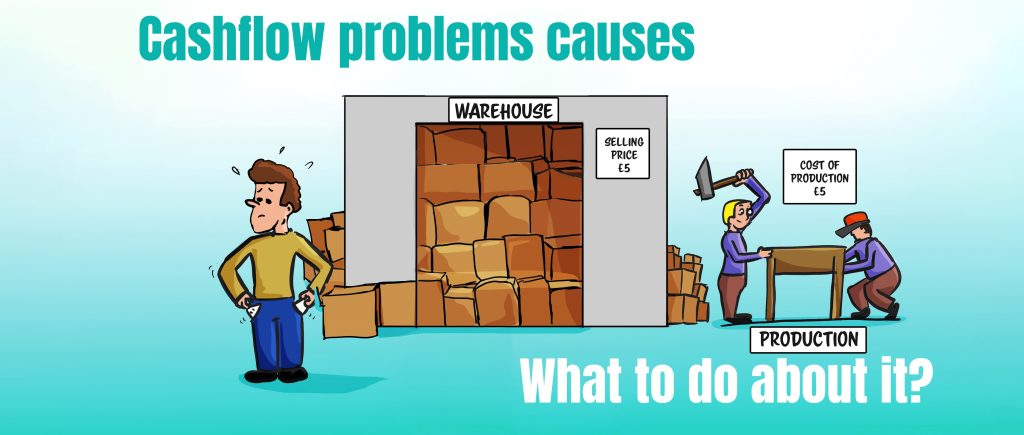

What causes cashflow problems and what can you do about it?
The truth of it is that lots of businesses don’t have enough cash and are living day-to-day.
Most have just enough to get by.
Some don’t…and they have a cashflow problem.
For business owners who find themselves grappling with a cashflow problem the tendency is to get a loan and cross their fingers that things will sort themselves out.
That rarely happens and it’s only a matter of time before the next cashflow problem is around the corner.
The ONLY way to avoid another cashflow problem is to fix whatever is causing it.
In this article, I’ll outline the six most common reasons why businesses have a cashflow problem and will give some practical ideas to help solve them.
Let’s get started….
CAUSE 1 - LACK OF PROFIT
Where a business has more cost than its’ sales then, over time, it’s inevitable that there will be a cashflow problem. The higher costs means more cash is leaving the business than what’s coming in from the sales receipts.
When faced by a lack of profit most business owners just focus on cutting costs.
IDEA: Review costs on a quarterly basis and either reduce or cut back on anything which isn’t delivering value.
BUT. In my experience the lack of profit is more likely to be caused by sales being too low and the common reasons for that I see are…..
- Ineffective or non-existent marketing (not attracting enough of the right customers)
- Poor sales conversion rates (converting leads into too few customers)
- Sales prices are too low (resulting in low profit margins)
IDEA: Review the sales numbers to establish which ones are not where they should be and then focus on improving them
CAUSE 2 - CUSTOMERS TAKE TOO LONG TO PAY
This is a really common problem and affects probably every business – except maybe those who only accept cash.
The three most common root causes which mean customers take too long to pay are:-
- Give too much credit. Many businesses automatically give 30 (or 60) days credit when your terms could / should be much shorter at say 7 days credit.
- No process. Without a clear process which is consistently checked by whoever is responsible then debt collection will at best be sporadic and it takes longer to get the cash in.
- No automation. If you don’t have a system which automatically collects cash from customers (via DD or credit card) then it’s doubtful you’ll get paid on time most of the time.
IDEA: You’ll find lots more useful practical ideas on this to improve cashflow in our article titled ‘How to improve cashflow’
CAUSE 3 - TOO MUCH STOCK
When stock is bought cash leaves the business and that cash only comes back in once the stock is sold and your sales invoices are paid.
The two common reasons why businesses have too much stock and too little cash is because:-
1. Extensive Product Range. To cater for the maximum number of customers there is a tendency to offer a wide range of products. The wider the range the more stock there will be and that consumes cash.
IDEA: Trim the product range and sell off discontinued products.
2. Rapid Delivery. To offer a same day delivery service a business has to have high stock levels which
is ready to go. More stock requires cash.
IDEA: A slight change (to say 2 to 3 days) in the speed of delivery could allow stock levels to be lower because there’s enough time to get the stock in before it needs to be shipped out.
CAUSE 4 - OVERTRADING
Overtrading happens when a business grows too quickly BUT it doesn’t have enough cash resource to support that growth. As the business grows a ‘cash gap’ is created and starts to widen.
A ‘cash gap’ is created because the business uses lots of cash NOW to pay the cost of more staff, more marketing, more raw materials, etc. to grow the sales.
BUT The business then must wait (possibly for several months) for the sales to be made and then for the customers to pay the invoice.
It’s this time delay between spending the cash now and waiting for the customers to pay which consumes cash.
IDEA: To avoid running out of cash through overtrading have a financial plan as it will show you how much cash resource is needed to finance the growth.
CAUSE 5 - UNPLANNED SPENDING
Unplanned spending is when costs are incurred but were never planned (or budgeted) for. This will always happen because you can’t foresee and put money aside to cover every eventuality.
Some examples of unplanned spending include…..
- Buying bulk buy goods or services before an announced price rise – this will typically save cash in the long run.
- Equipment repairs – impossible to predict when equipment will break down but when it does it needs to be repaired straightaway.
IDEA: Need to be aware when unplanned spending happens and decide if there is enough cash in the business to pay for it – if there isn’t then one option is to look to trim some planned spending.
CAUSE 6 - LACK OF PLANNING
Any business owner who is serious about growing and being profitable needs to have a financial plan.
A financial plan is like having your car’s SAT NAV but in your business.
- It clearly shows your destination, AND how you’re going to get there.
- Every step of the way it tells if you’re on track or not
- If you’re not on track it tells you straightaway – meaning you can quickly assess your options & take corrective action to get you back on track.
Most business owners though don’t have a financial plan which means they’re essentially running their business, and making important decisions, blind.
For instance.
A business maybe thinking about giving customers extended credit as a way of increasing sales. That decision could lead to the business failing because it runs out of cash. This disaster could be avoided by having a financial plan which showed the impact of giving extended credit.
Planning is imperative for start-up businesses. In the early days there will be lots of start-up costs (eg website & marketing campaign) to pay for but there is little income because it takes time to get customers and make sales.
IN SUMMARY
For any business owner who finds themself with a cashflow problem the most important thing is find out what is really is causing the cashflow problem….and take immediate action to fix it.
Even better is to avoid a cashflow problem arising in the first place….and the best way to do that is to have a financial plan for your business which you then deliver.