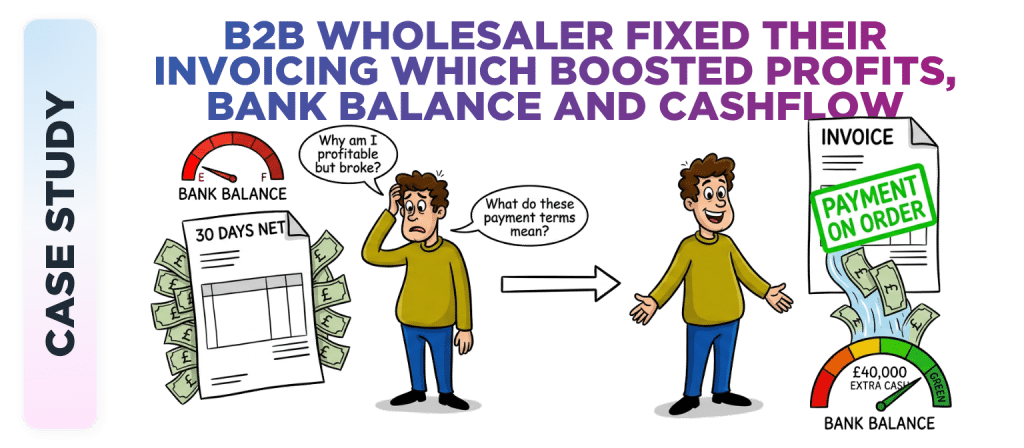
B2B wholesaler fixed their invoicing which boosted profits, bank balance and cashflow
Jane is the owner of a £500,000 turnover B2B wholesale business.
On the surface, everything seemed fine. She had a steady flow of customers, her products were moving, and her team was solid.
But there was one massive problem: her business was running out of cash.
And, as any business owner knows, cashflow problems are one of the quickest ways to feel anxious and overwhelmed. This wasn’t just a small concern – it was a full-on crisis. She knew she needed money to keep things running smoothly, and her first instinct was to take out a business loan.
But luckily, I could see things from a different perspective.
Instead of jumping straight into borrowing money, I suggested we first get to the root cause of the problem. And, as I always say, “You need to know why before you can think about how.”
The Clear Plan: Finding the Real Cause of the Cashflow Crunch
In every case I’ve worked with, when cashflow goes south, I start by looking at two things:
Profit
Is the business generating enough profit to support its operations?
Working Capital
Is there too much cash tied up in things like stock or unpaid sales invoices?
The Solution: A Simple but Effective Change
In Jane’s case, a quick review of her Profit & Loss report revealed her sales were only £1,000 short each month. That didn’t seem like enough to cause a major cashflow problem.
So, I moved on to the next step: reviewing her Balance Sheet.
What I discovered was startling. Jane’s business had far too much cash tied up in working capital – specifically, in the £70,000 of unpaid sales invoices.
The root of the problem? Jane’s credit terms.
She was offering 30-day net payment terms to all her customers. While that may have seemed “normal” for B2B businesses, it was seriously harming her cashflow. On average, it took over 45 days for her customers to pay – and sometimes even longer.
The solution was surprisingly simple: change the credit terms.
I recommended that Jane reduce her payment terms for all new customers and smaller existing ones to payment on order rather than 30 days net.
This seemingly small shift had a huge impact:
- £40,000 extra cash in her bank account.
- A dramatic reduction in the time wasted chasing late-paying customers.
- A lower level of bad debt.
The Results: A Transformed Business and Mindset
The effects were pretty much immediate.
Jane’s cashflow went from being in the red to comfortably in the black.
Not only did she have the cash she needed to keep her business running, but the changes also made her feel more in control of her business and less stressed about finances.
Jane could finally breathe easy, knowing her business was no longer in a precarious cashflow situation. With the spare cash, she was able to reinvest in her business, and her profit margins improved as well.
Ready to Transform your Business?
Just like Jane, you don’t have to rely on loans to solve your cashflow problems. Sometimes, the solution is simpler than you think.
If you’re ready to take control of your cashflow and boost your profits, let’s talk. I can help you identify the gaps in your numbers, create a solid financial plan, and show you how to unlock more cash for your business.
Don’t wait, take action today and set your business up for success.
To get in touch you can drop us an email to [email protected] or call one of the team on 0161 410 0020.
Disclaimer
You must take professional advice before making any decisions based on the information that you have learnt here. While every effort has been made, to make sure it is accurate it cannot be precisely tailored to your personal circumstances. This article is for general information only and no action should be taken, or refrained from, as a result of this information. Professional advice should be taken based on specific circumstances in each individual case. Whilst we endeavor to ensure that the information contained in the article is correct, no liability will be accepted by Krystal Clear Accounting which is a trading name of Kim Marlor Associates Ltd or damages of any kind arising from the contents of this communication, or for any action, inaction or decision taken as a result of using any such information.